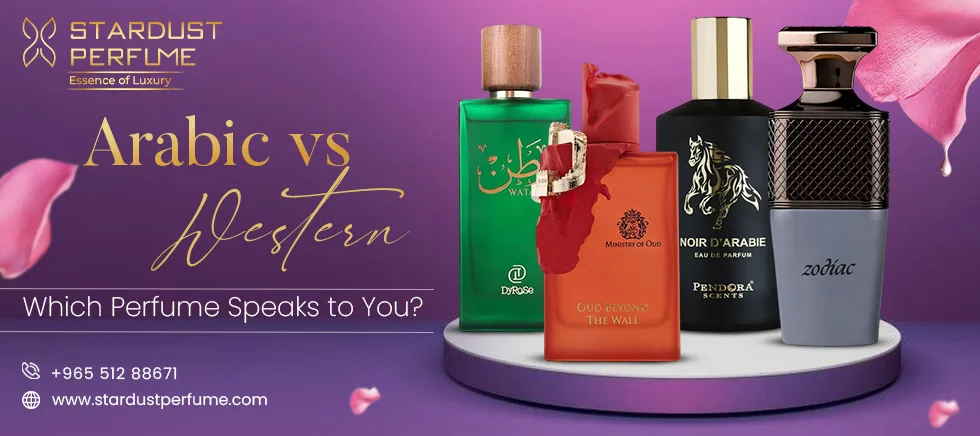
The East-West Perfume Paradox: Which World Speaks To You?

Have you ever stood in front of your perfume wardrobe and felt torn between that rich, smoky oud perfume and a lighter floral Eau de Parfum? You are not alone. In our experience of working with connoisseurs and collectors at Stardust perfume, we often see this tension:
Should you lean towards Arabic or Western? Today we’ll share how to choose a scent that truly resonates with you. So you understand whether your preference lies in opulence or subtlety. Our aim here is to help you discern which style best reflects your persona, setting, and mood.
The Foundations: What Sets Arabic And Western Apart
There is more than meets the nose when you compare Arabic and Western perfumes. Because Arabic perfumery evolved in desert climate and cultural settings, its method prioritised oils that cling to skin, evolve slowly, and endure. Western perfumery, on the other hand, emerged in temperate climates, favouring volatility and brightness.
Here are key contrasts:
| Aspect | Arabic Perfumes | Western Perfumes |
|---|---|---|
| Base / Carrier | Largely oil-based or high concentration, with fewer alcohols | Commonly alcohol-based, with more dilution and volatility (% of fragrance in solution) |
| Longevity & Projection | Enduring. Some long lasting perfumes i.e, 24+ hours; strong presence | Typically 4–8 hours for eau de parfum, projection is more modest |
| Note Profile | Rich woods (oud), amber, resin, musk, spices, exotic florals | Fresh florals, citrus, aquatic accords, lighter woods, fruity notes |
| Evolution on Skin | Complex layering, smoky, resinous, leathery, balsamic stages | More linear, top ? heart ? base in a shorter period |
| Cultural Context | Woven into traditions of hospitality, gifting, layering | More seasonal, fashion-driven, trend responsive |
The Power Of Oud In Arabic Perfumes
-
Oud (agarwood) is resinous heartwood formed when Aquilaria trees respond to fungal infection.
-
In the Middle East, oud is considered “liquid gold”, rare, prized, and symbolic of prestige.
-
Its scent profile is layered: you may detect leather, smoke, balsam, honey, earth, or incense in a single bottle.
-
As a base, it supports long wear, resonant sillage, and an evolving story on skin.
Western perfumers use oud too, but often as an accent or facet, softening it with florals, musks, woods, or gourmand notes. That way they preserve some depth without being overwhelming.
Why One May Suit You Over The Other
Let us walk you through key considerations to decide your path or combination.
A. Your Environment & Climate
In hot climates like the UAE or Kuwait, lighter scents often dissipate. Arabic perfumes, with their oil bases and deeper molecules, cling longer. Many Western scents lose their brightness too soon indoors or under the sun.
B. Purpose & Occasion
-
Seeking a commanding scent for gala dinners or evening events? Oud Arabias often make a lasting impression.
-
For office, daytime meetings, or travel, a lighter Western scent or a hybrid blend may feel more comfortable.
C. Layering Preferences
If you enjoy personalising scent or layering, Arabic perfumes give a base you can layer over. Many collectors blend attars or oils with sprays to shape their style.
D. Collector’s Disposition
Many of your peers collect for artistry, uniqueness, and signature identity. Arabic perfumes often offer rarer extracts, unusual woods, and dramatic development—ideal to showcase. In forums and reviews, buyers often say Middle Eastern fragrances “outperform Western designer ones” in longevity and presence.
How To Explore And Select Arabic Perfumes
Here is our process when we guide discerning clients:
Step 1: Profile Your Style
We ask: Do you prefer bold declarations or soft whispers? Are you drawn to woods, florals, gourmands? What kind of lifestyle do you lead, like jet setter, boardroom, red carpet, intimate evening?
Step 2: Side-by-Side Comparison
We arrange samples from your region’s Arabic houses and Western haute parfumerie. We encourage testing on skin, not just blotters, and observing the evolution over hours.
Step 3: Hybrid Experimentation
A potent method is fusion:
-
Spray a Western scent first for brightness, then top or boost with an Arabic oil or attar.
-
Use a softer Arabic blend by day, and layer a deeper Arabic perfume for evening.
Once you land on your scent, you might lock in a signature, something that becomes unmistakably yours. That is part of the luxury of collecting. We ensure your selection stands apart.
Sample Houses to Try (Especially In Our Collection)
Because you already deal with many top fragrance houses, here are ones that illustrate the contrast or fusion beautifully. Test them and observe how they unfold.
-
ZODIAC — Blends oud with florals and woods, bridging East and West
-
SAMAM — Deep, rich unisex oud classics
-
PARIS CORNER — Creative modern Arabic blends that nod to Western styles
-
Lattafa — Accessible Arabic fragrances with strong identity
-
Lord of History — Bold leather + oud tendencies
By sampling these, you gain a nuanced feel for each style’s strength.
Your Olfactory Identity Awaits
Both perfume styles are not rivals, but complementary expressions. One may speak louder, another softer, but both can be harmonious when used discerningly. Arabic perfumes for men and women are known for their deep, luxurious notes of oud, musk, and amber that create a lasting impression. Western perfumes, however, offer lighter, fresher blends with floral, fruity, or citrus tones. We encourage you to explore with care, to test, to layer, and to discover the scent that feels like home around your skin and among your presence.
If you’d like a curated shortlist based on your personal style, or a side-by-side test set from the houses you already represent, we invite you to explore Oud Arabia and other fragrances, exclusively with us at Stardust Perfume.